
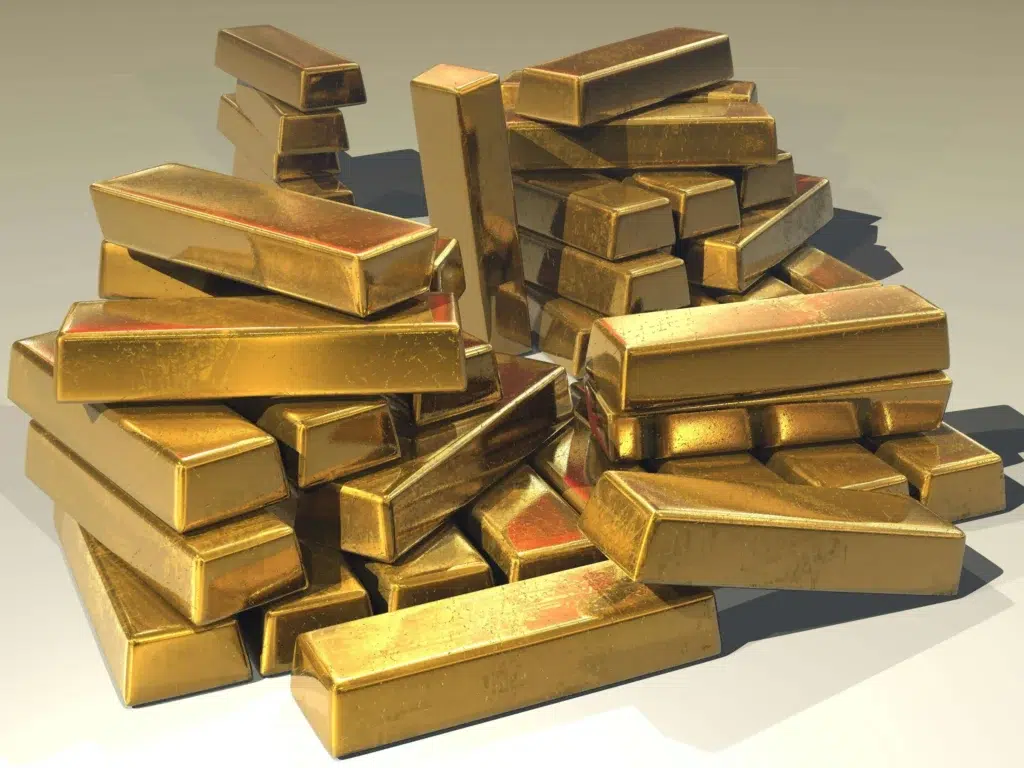
Recently, most analysts have been repeatedly forecasting that precious metals prices will continue to trend upwards. Gold-backed exchange-traded funds (ETFs), introduced in the early 2000s, substantially broadened the investor base for gold and allowed for more rapid shifts between gold and other assets in response to such shifting beliefs.
Gold can also provide private investors with an effective hedge against other forms of risk, including uncertainty about economic prospects that can hurt the stock market. Gold is frequently viewed by investors as a “safe haven” in times of economic turmoil. And gold is often seen as a tool to protect against inflation.
Rising inflation can undermine the value of cash and fixed-interest rate assets like treasury bonds. Holding gold protects against such capital losses in the face of rising inflation because the price of gold tends to rise as the real values of these other assets fall.
An additional factor affecting the gold price is that central bank demand for gold has risen since the sanctions imposed on Russia after it invaded Ukraine. Gold was a key component of central bank reserves from 1945 to 1973, under the fixed exchange rate system in which the prices of all major currencies were tied to the value of the U.S. dollar, and the dollar was fully convertible into gold at $35/ounce. The fixed dollar price of gold was protected by large official United States reserve holdings.
Other major central banks also held substantial gold reserves. The role of gold as a central bank reserve diminished after this system collapsed in March of 1973, but it did not disappear. Since 1973, major central banks have continued to hold gold in their international reserves even though it is no longer required to back their currency. Such holdings represented a rising share of the value of their international reserves as the gold price increased over this period.
Since 2010, the central banks of Russia and China, among others, have been increasing their physical holdings of gold, as part of a reserve diversification strategy out of US-dollar assets. And central bank purchases of gold decisively accelerated after the February 2022 Russian invasion of Ukraine, which led Western governments to impose sanctions on Russia, including freezing dollar-based reserves.
Since then, central banks of Poland, China, Turkey, and India, among others, have substantially increased their gold purchases, raising aggregate central bank holdings of gold by over 1000 tons each year, about twice the amount of central bank gold acquisitions over the 2010 – 2021 period.

Global Gold Mining and Production
Recently, we have been in a new supercycle, driven primarily by steadily and decisively increasing gold market demand.
Continuation of this trend was accurately forecasted by Marks Lisnanskis in his 2020 interview to Egypt Oil & Gas Magazine.
From 1959 to 2024, gold production increased almost 2.5 times (by almost 150%). At the same time, the world population increased almost 2.8 times (by almost 180%). Thus, we now produce significantly less than the amount of gold per capita that we did back in 1959. Gold production per capita during the last 100 years averaged approximately 0.37 grams. Calculations of the relation between global gold production and the world population reveal that.
These fundamentals are a separate matter from the inevitable inflationary environment, particularly in the United States, which drives the recent rapidly increasing market demand for gold – resulting in an upward price trend.
The exponential growth of the money supply has proven to be irreversible and has continued to increase. Staggeringly, from 1959 to 2025 American money supply M3 increased 70 times (by an astonishing almost 7000%). Starting March 2006, the U.S. Federal Bank stopped providing information about the amount of dollars printed.

Gold Market Type and Structure
Gold markets represent special gold trading hubs where gold is regularly traded at market prices. A troy ounce equals 31.1034768 grams (the name originated from the French city of Troyes).
The organizational pattern of a gold market is represented by an association of major reputable banks that are licensed to deal in gold. They act as agents in transactions between gold buyers and sellers. To do it, such markets collect their requests, compare them, and register the average market gold price generally twice a day, subject to mutual agreement.
There are well over 50 active gold markets around the world. The largest of them include London, Zurich, New York, Hong Kong, and Dubai. The primary leaders are London and Zurich.
The key sources of supply for these markets generally include offers from gold mining companies. Recently, the volume in that category amounts to approximately 2500 tons per year. The other categories of supply include: national gold reserves of different countries, gold reserves of private banks, and gold offered by major and minor dealers.
Key sources of demand for gold include central banks (growth/replenishment of national reserves); private banks (purchasing ingots, coins, etc.); other investors (ETFs and such); jewelry industry; and various industrial enterprises.
Despite current relatively high prices, demand for gold remains strong in China, where buyers are willing to pay a premium for the precious metal. Similar purchases are occurring across Asia.
ETFs are steadily in high demand, so that market sector may eventually become the most attractive in the years to come. Investors are buying shares, and numerous national central banks continue purchasing gold to increase their reserves. The most active purchasers of gold over the last months were central banks of emerging economies.
For example, the Central Bank of India has also been gradually increasing its gold reserves, along with local jewelers and dealers.

Prevailing Trend
The consensus is that some economies may experience a slight recession in the first quarter of the year and possibly beyond, which could cause central banks to decrease their rate of interest hikes and make gold more appealing as an investment.
Important to note, gold is the only asset that every central bank owns. It is a good hedge against inflation, which now appears to be inevitable to materialize, or stagflation.
Many market strategists are recommending allocating 10-20% of any investment portfolio to gold for the coming year(s).
The track record during this century shows that the average return on gold in any currency has been somewhere between 8% and 10% per year. Such ROI has not been achieved in the bond market or in the equity market.
Demand for gold continues to increase from various market sectors, including jewellers, investors, as well as various industrial uses.
Global appetite for gold is running at its hottest pace in decades. Supply, meanwhile, is growing by barely one percent a year. When booming demand meets tight pipelines, prices tend to march higher.That backdrop makes the case clear: owning real, responsibly-sourced metal isn’t just a hedge—it’s a timely opportunity. Our shop lets you buy gold coins online. If you’ve been waiting for the right moment to add gold, the market is sending a loud signal—step in now and secure your share of tomorrow’s limited supply.