Spot gold price today
Given gold’s breakthrough in 2025 and its record price right now, investors are asking the question “What’s next?“. Will gold prices decline again after this spike? Will they continue rising?
Understanding the gold market requires analyzing various factors that affect gold price movements. Various forces shape the gold price outlook for the years to come. We’re here to help you find your way in this complex gold market landscape.
As of July 3, 2025, gold’s price sits at about $3,369 per ounce. Here are some of its key performances in 2025 that are important to note:
- It gained over 25% in 2025
- Broke through resistance levels
- Set new all-time highs above $3,400 per ounce
- Performed better than most major asset classes
It is no surprise that investors strive to put their wealth in gold. The demand for this precious metal is currently very high.
There are a couple of reasons behind this spectacular performance:
- Central bank purchasing programs are at all-time highs.
- Concerns about currency devaluation.
- Inflation fears.
- Geopolitical tensions – they drive safe-haven demand.
Gold’s supply and demand
Supply factors:
- Mine production growth has slowed
- New mine discoveries at multi-decade lows
- Existing mines are facing higher extraction costs
- Environmental regulations are limiting new development
Recently, it’s been hard to supply gold. Still, it is in high demand.
Demand drivers:
- Investment demand (ETFs, bars, coins): varies
- Jewelry demand: about 2,000 tonnes every year
- Technology uses: about 300 tonnes
- Central bank purchases: 1,045 tonnes in 2024
As for what can be seen from this, the gold prices are rising. There is a lot of demand, but a very limited supply. However, it all depends on many things besides this factor — multiple reasons affect the price of gold.
Key factors affecting gold price
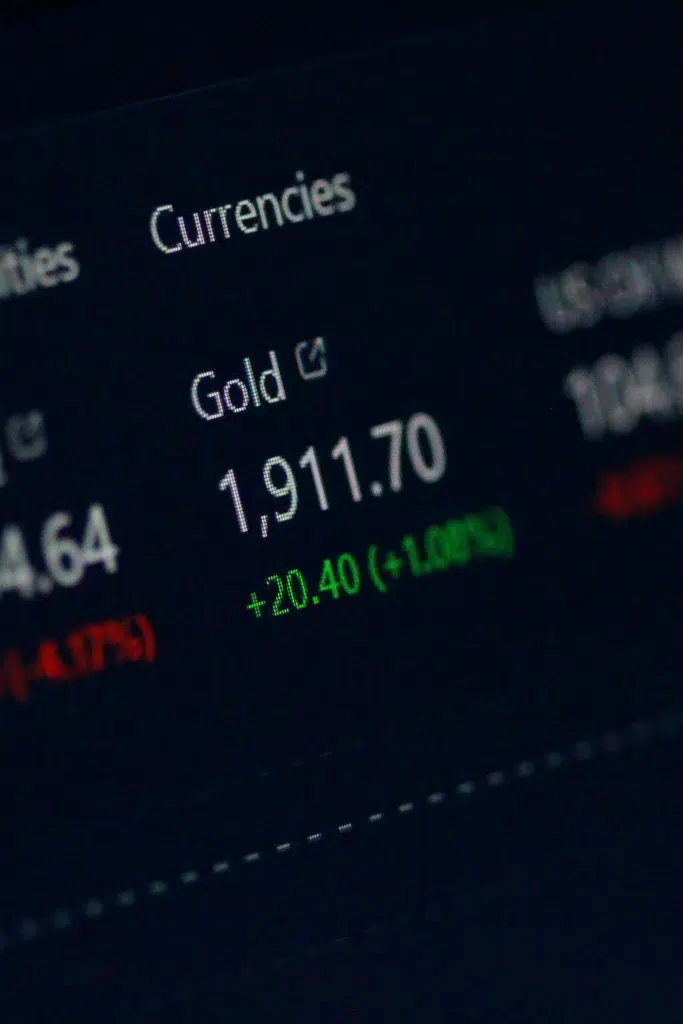
Gold responds to many economic, political, and market forces at the same time. Understanding those forces helps investors anticipate gold’s performance in the future.
- Central Bank Policies
- Inflation Expectations — rising inflation makes gold a more attractive option.
- Geopolitical Events — political instability has people wanting a safe-haven option.
- U.S. Dollar Strength — dollar weakness typically supports gold.
Remember that gold price volatility means there can be dramatic short-term movements in both directions. For investors, long-term growth should matter more than daily price fluctuations.
Gold price prediction
Predictions for the price of gold vary slightly when it comes to different scenarios. However, a general statistic can be made, and by checking and tracking gold’s price regularly, you can make decisions that best preserve your wealth.
- Goldman Sachs: proposes $3,100 by December 2025, with upside to $3,200 if central-bank buying averages 70 tons monthly.
- J.P. Morgan: projects an average $3,675/oz in Q4 2025, citing constrained mine supply as his reason for high price predictions.
- Consensus long-range calls (Bloomberg & Axi surveys) cluster between $3,200–$4,000 by 2030, reflecting divergent views on U.S. debt sustainability and dollar strength.
Road-map:
1. Base case (middle ground) – $3,300-3,500 through 2026 if real yields stay low and central-bank demand normalises.
2. Bull case (highest) – Break above $3,800 by 2027 on renewed economical or geopolitical shocks.
3. Bear case (lowest gold price) – Slip toward $2,700 by 2026 if real yields rise above 1 % and ETF outflows resume.
The takeaway is: Gold’s future path depends on real rates, central-bank purchases, and shocks. Currently, market structure suggests a favorable path for gold to new highs. For investors, the best choice is holding or adding a bit to positions while keeping watch over the current market.
Gold Price Chart
Historical Gold Prices in USD per Troy Ounce